
Boat Storage in St. George, Utah: Covered vs. Uncovered Options for Southern Utah Boat Owners
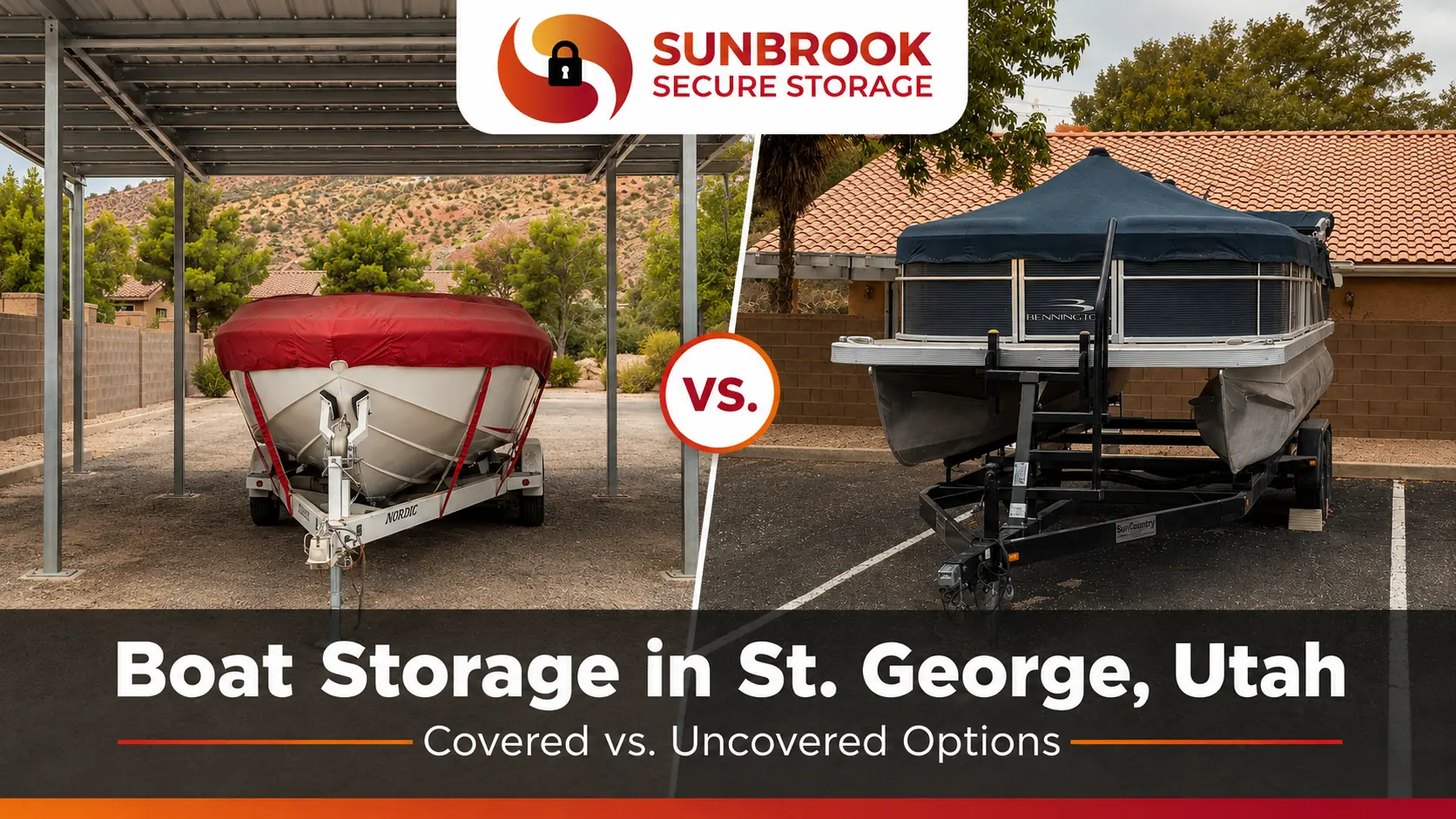
When you're looking for boat storage in St. George, Utah, the decision usually comes down to two options: covered or uncovered parking. Both can work well, but the better choice depends on your budget, how long you store your boat, your boat's materials, and how much protection you want from Southern Utah's intense sun and weather.
Here in St. George, boats aren't just toys—they're how many of us spend our weekends at Sand Hollow and Quail Creek. But when the boating day is over, your boat and trailer need a place to park that doesn't involve turning your driveway into a permanent marina. At Sunbrook Secure Storage, we offer both covered and uncovered outdoor boat parking so you can choose the option that fits your boat, your trailer, and your budget.
Quick Answer
Covered boat storage in St. George, Utah reduces direct overhead sun and weather exposure, which can help slow wear on upholstery, covers, and trailer components. Uncovered boat storage is a simpler, more budget-friendly option that works well for frequently used boats protected by a fitted cover. The right choice depends on your storage duration, your boat's materials, and current space availability—so always confirm the exact space size with the facility before renting.
Key Takeaways
- Covered parking reduces direct overhead exposure from sun, rain, and debris, but it is still outdoor storage—not a fully enclosed indoor unit.
- Uncovered parking is straightforward and budget-friendly, especially for boats that are already protected by a quality fitted cover and used frequently.
- Measure the complete boat-and-trailer combination, including the trailer tongue, motor, and any rear-mounted equipment—advertised boat length rarely tells the full story.
- Confirm exact space size and current availability with the facility before arriving with your boat and trailer.
- Proper boat preparation still matters regardless of which parking type you choose—cleaning, covering, and maintenance are essential.
- Southern Utah's sun is hard on boats, so even covered parking benefits from a fitted, breathable cover and routine inspections.
Table of Contents
- Covered vs. Uncovered Boat Storage: The Quick Answer
- Why Boat Storage Matters in St. George's Climate
- Benefits of Covered Boat Storage in St. George
- When Uncovered Boat Storage May Make Sense
- How to Measure a Boat and Trailer for Storage
- Preparing a Boat for Storage in Southern Utah
- Boat Storage Near Sand Hollow and Quail Creek
- What to Compare When Choosing Boat Storage
- Boat and Trailer Storage at Sunbrook Secure Storage
- Frequently Asked Questions
- Find Boat Storage in St. George, Utah
Covered vs. Uncovered Boat Storage: The Quick Answer
Covered boat storage provides a roof over your boat and trailer, reducing direct exposure to overhead sunlight, rain, and falling debris. Uncovered boat storage is open-air parking—essentially a designated parking space without a roof. Both are outdoor parking options, not enclosed indoor storage.
Here's a side-by-side comparison to help you think through the trade-offs:
| Consideration | Covered Boat Storage | Uncovered Boat Storage |
|---|---|---|
| Direct sunlight | Reduced overhead exposure; sides still open | Full sun exposure on all surfaces |
| Overhead weather | Roof deflects rain, hail, and debris | No overhead protection |
| Cost expectations | Generally higher monthly cost | Generally lower monthly cost |
| Frequent use | Works well; cover still recommended | Very convenient for quick access |
| Long-term parking | Often preferred for seasonal storage | Suitable with a quality cover |
| Boat cover needed? | Yes—covers add a second layer of protection | Strongly recommended |
| Availability | Limited spaces; confirm with facility | Typically more spaces available |
Note: Covered parking is not the same as fully enclosed indoor boat storage. Your boat remains outdoors with overhead protection only.
Why Boat Storage Matters in St. George's Climate
If you've lived in Southern Utah for long, you know the sun here doesn't take days off. St. George regularly sees summer temperatures above 100°F, and the UV index in Washington County is among the highest in the state. That combination of heat and intense sunlight takes a toll on boats parked outdoors for months at a time.
Here's what prolonged outdoor exposure can affect:
- Upholstery and vinyl seats—fading, cracking, and drying out
- Boat covers—faster wear and UV breakdown of fabric
- Tires—dry rot and sidewall cracking from sun exposure
- Seals and rubber components—premature aging
- Trailer components—paint fading, light lens clouding, bearing grease breakdown
- Gel coat and fiberglass—oxidation and fading over time
Southern Utah also brings dust and wind. Fine red dust finds its way into every crevice, and windstorms can deposit grit across uncovered boats even when a cover is in place. Covered parking won't eliminate heat or weather exposure—your boat is still outdoors—but it does reduce the direct overhead punishment that causes the most visible wear.
Benefits of Covered Boat Storage in St. George
Covered boat storage is often the first choice for boat owners who store their boats for longer stretches between outings. The overhead roof provides a meaningful layer of protection that open-air parking simply can't match.
Here's why covered parking appeals to many Southern Utah boat owners:
- Reduced direct overhead sunlight—the roof blocks the most intense midday UV exposure that fades upholstery and gel coat.
- Additional protection from overhead weather—rain, hail, and blowing debris hit the roof instead of your boat.
- Less wear on covers and exposed materials—a fitted cover under a roof lasts longer than one baking in full sun.
- Appeal for long-term or seasonal storage—snowbirds and seasonal residents often prefer covered spaces for boats parked through the off-season.
That said, covered storage is not a substitute for a good cover and routine maintenance. A fitted, breathable boat cover still matters, and you should inspect your boat periodically even when it's parked under a roof. Covered parking reduces exposure—it doesn't eliminate it.
When Uncovered Boat Storage May Make Sense
Uncovered boat storage gets a bad rap sometimes, but for the right boat owner it's a perfectly practical option. If you use your boat every weekend during the summer, the convenience of quick access may matter more than overhead protection.
Uncovered parking may be the right choice if:
- You use your boat frequently—weekly or biweekly trips to Sand Hollow mean less downtime for sun damage to accumulate.
- You want a straightforward parking solution—no roof, no frills, just a designated space.
- Your boat is already protected by a fitted, weather-resistant cover—a quality cover does a lot of the heavy lifting.
- You're storing for a shorter period—a few weeks or a month between outings is less demanding than a full off-season.
- Budget is a primary consideration—uncovered parking is generally the more affordable option.
The key with uncovered storage is diligence. Inspect your boat, check your cover, and keep up with trailer maintenance. A boat sitting in full Southern Utah sun needs more attention than one under a roof, but with the right cover and routine care, uncovered parking works well for many owners.
How to Measure a Boat and Trailer for Storage
One thing we see all the time: boat owners rent a space based on the advertised boat length, only to discover the trailer tongue and motor add several feet they didn't account for. Choosing a storage unit that's too small is like trying to fit a king-size mattress into a compact car—it can be done, but it usually doesn't end well.
Measure the complete stored configuration of your boat and trailer, including:
- Trailer tongue or hitch (often 3–5 feet beyond the boat's bow)
- Bow pulpit or extended bow
- Swim platform at the stern
- Outboard motor in the tilted/stowed position
- Propeller clearance
- Spare tire mounted on the trailer
- Guide posts or bunks that extend beyond the hull
- Wakeboard tower or other elevated equipment (for height clearance)
- Trailer width (including fenders and guide posts)
- Overall height when the boat is on the trailer
Practical example: A boat advertised as "21 feet" may actually need a parking space of 26 feet or more once you add a 4-foot trailer tongue, a swim platform, and an outboard motor in the stowed position. This is an example, not a guaranteed sizing formula—every boat and trailer combination is different.
Leave a reasonable margin rather than renting a space that matches your measurement exactly. Tight fits make loading and unloading stressful, and they leave no room for error. At Sunbrook, covered parking spaces are approximately 12 feet wide and available in lengths ranging from approximately 20 to 70 feet, with uncovered parking in sizes including approximately 9×20, 10×20, 11×30, 11×35, and 12×40. For help choosing a unit for your personal belongings, see our storage unit size guide. Always contact us to confirm which spaces currently fit your boat and trailer.
Preparing a Boat for Storage in Southern Utah
Whether you choose covered or uncovered parking, proper preparation protects your investment. Here's a checklist to work through before you park your boat for any extended period:
- Clean and thoroughly dry the boat. Salt, sand, and organic debris cause stains and corrosion over time.
- Remove food, trash, and damp equipment. Leftover gear and moisture invite mold and pests.
- Drain applicable water systems as recommended by the manufacturer.
- Protect upholstery and interior surfaces with appropriate conditioners or covers.
- Use a fitted, breathable, weather-appropriate boat cover. Avoid tarps that trap moisture.
- Check trailer tires and inflate to the manufacturer's recommended pressure.
- Inspect the hitch, bearings, lights, and safety chains. Address any issues before storage.
- Secure loose accessories—remove or tie down anything wind could catch.
- Follow the manufacturer's battery and fuel-storage instructions. Don't guess on fuel stabilizers or battery disconnects.
- Follow manufacturer guidance for winterization or extended storage. Southern Utah winters are mild, but extended storage still requires proper preparation.
- Check the boat periodically. Visit your boat, inspect the cover, and look for signs of pests or weather damage.
Always follow the boat, motor, battery, and trailer manufacturers' recommendations or consult a qualified marine professional for storage-specific maintenance.
Boat Storage Near Sand Hollow and Quail Creek
If you boat in Southern Utah, you probably know Sand Hollow State Park and Quail Creek State Park. These two reservoirs are among the most popular boating and recreation destinations near St. George, drawing boaters from St. George, Washington, Santa Clara, Ivins, and beyond.
Sand Hollow State Park offers warm-water boating, fishing, and camping with striking red-rock views. Quail Creek State Park provides a quieter boating experience with cooler water. Both are managed by Utah State Parks, and both are popular with local boat owners who need a convenient place to store their boats and trailers between outings.
For boat owners who live in or near St. George, having a storage facility on Dixie Drive means your boat is parked close to home—and reasonably close to the reservoirs when it's time to hit the water. We won't quote exact drive times because traffic and route choices vary, but the convenience of central St. George storage is a real benefit for anyone who boats regularly at Sand Hollow or Quail Creek.
What to Compare When Choosing Boat Storage
When you're comparing boat storage facilities in St. George, use this checklist to make sure you're comparing apples to apples. For current rates, see our storage unit cost guide for St. George.
- Space dimensions—exact width and length of the parking space
- Covered versus uncovered configuration—what type of overhead protection is actually provided
- Ability to maneuver a tow vehicle and trailer—wide drive aisles make backing in much easier
- Access policies—when you can reach your boat and how you enter the facility
- Current availability—covered spaces often fill up faster than uncovered
- Rental terms—month-to-month flexibility versus longer commitments
- Payment options—online account management and autopay
- Facility rules—what's allowed and prohibited on the property
- Insurance responsibilities—what coverage you're expected to carry
- Boat-cover requirements—some facilities require covers; some don't
- Prohibited maintenance or repair activities—most facilities don't allow major work on-site
- Whether the complete boat-and-trailer combination fits—measure first, rent second
Boat and Trailer Storage at Sunbrook Secure Storage
At Sunbrook Secure Storage, we offer both covered and uncovered outdoor parking for boats, RVs, and other vehicles at our facility on 415 S Dixie Drive in St. George. Covered parking spaces are approximately 12 feet wide and available in lengths ranging from approximately 20 to 70 feet. Uncovered parking is available in sizes including approximately 9×20, 10×20, 11×30, 11×35, and 12×40.
Availability changes throughout the year—especially as boating season approaches—so we always recommend contacting us before arriving with your boat and trailer. We'll help you confirm which spaces currently fit your complete boat-and-trailer combination.
If you also need covered and uncovered vehicle-storage options for an RV or trailer, our team can walk you through what's available. We also offer U-Haul rentals, packing supplies, online payments, and indoor air-cooled storage units for your other belongings—but we'll keep the focus on your boat for now.
For more on protecting recreational vehicles from Southern Utah heat, read our guide on RV storage in Southern Utah. To understand how heat affects stored items, see our article on how heat can affect stored belongings. And if you're comparing storage types, our indoor versus outdoor storage guide breaks down the differences.
Measure your complete boat-and-trailer setup, then contact Sunbrook Secure Storage to ask which covered or uncovered parking spaces are currently available.
Frequently Asked Questions About Boat Storage in St. George
Is covered boat storage worth it in St. George, Utah?
Covered boat storage is worth it for many St. George boat owners because it reduces direct overhead sun and weather exposure, which helps slow wear on upholstery, covers, and trailer components. If you store your boat for weeks or months at a time, covered parking offers meaningful protection. For boats used every weekend, uncovered parking with a quality cover can also work well.
Is covered boat storage the same as indoor boat storage?
No. Covered boat storage is outdoor parking with an overhead roof. Your boat remains exposed to ambient heat, dust, and side-blown weather. Indoor boat storage would mean parking inside a fully enclosed building. Sunbrook offers covered and uncovered outdoor parking, not enclosed indoor boat storage.
How do I know what size storage space my boat needs?
Measure the complete boat-and-trailer combination from the trailer tongue to the rear-most component—motor, swim platform, or spare tire. Include the trailer width and overall height. Then add a margin for easy loading. Always confirm the exact space dimensions and current availability with the facility before renting.
Should I cover my boat when it is parked under covered storage?
Yes. A fitted, breathable boat cover adds a second layer of protection against dust, wind-blown debris, and side exposure even under a roof. Covered parking reduces overhead sun but doesn't seal your boat from the environment. A quality cover is still recommended.
Can I store my boat and trailer together?
Yes. Boat and trailer storage at Sunbrook is designed for the complete boat-and-trailer combination. Measure the total length and width of both together, then confirm which parking spaces currently fit. Most boat owners store the boat on its trailer in the same parking space.
What should I do before storing a boat for several months?
Clean and dry the boat, remove food and damp gear, drain water systems per manufacturer guidance, protect upholstery, use a fitted breathable cover, check trailer tires and bearings, and follow the manufacturer's battery and fuel-storage instructions. Inspect the boat periodically during storage.
Does Sunbrook offer both covered and uncovered boat parking?
Yes. Sunbrook Secure Storage offers both covered and uncovered outdoor parking for boats, RVs, and vehicles in St. George. Covered spaces are approximately 12 feet wide with lengths up to about 70 feet. Uncovered spaces include sizes such as 9×20, 10×20, 11×30, 11×35, and 12×40. Contact us to confirm current availability.
Find Boat Storage in St. George, Utah
Choosing the right boat storage in St. George comes down to a few practical decisions:
- Choose covered parking when reduced direct overhead exposure is a high priority and you store your boat for longer stretches.
- Consider uncovered parking when your boat is properly covered and you want a straightforward, budget-friendly outdoor option.
- Measure the complete boat-and-trailer configuration before you rent—don't rely on advertised boat length alone.
- Confirm current availability directly with Sunbrook before arriving with your boat and trailer.
Whether you need covered or uncovered boat storage in St. George, Utah, our team is ready to help you find the right fit. Measure your complete boat-and-trailer setup, then contact Sunbrook Secure Storage to check which covered or uncovered parking spaces are currently available.

About The Sunbrook Team - Your Local Storage Experts
The Sunbrook Team specializes in indoor self storage and RV, boat, trailer and vehicle storage in St. George, Utah. From its facility at 415 S Dixie Drive, the team helps customers throughout Washington County compare storage sizes, prepare belongings and find practical storage options.
Related Articles
Storage Units for Snowbirds in St. George, Utah: What to Store Before Leaving for Summer
Leaving St. George for summer? Learn what to store, how to prepare belongings for Southern Utah heat, and how to choose an indoor air-cooled storage unit.
Indoor Self Storage Units in St. George, Utah
Compare indoor storage sizes, security and air-cooled features in St. George. Find the right Sunbrook storage unit and check availability today.
Month-to-Month Storage Units in St. George, Utah: Costs, Terms, and What to Expect
Looking for month-to-month storage units in St. George, Utah? Learn how flexible monthly rentals work, compare costs and terms, and reserve online.